Emergency stop buttons save lives in factories and workplaces every day. In 2026, emergency stop button standards: iso, IEC, and UL set strict requirements for design, safety, and performance. These standards demand that emergency stop buttons remain easy to reach and operate in any emergency. Safety matters most, but meeting safety standards also helps companies enter international markets. The table below shows how compliance with international standards connects to global market access:
| Standard | Requirement Description | Impact on Market Access |
|---|---|---|
| ISO 13850 | Emergency stop buttons must be easy to reach and operate. | Ensures safety, increasing buyer confidence. |
| IEC 60204-1 | Emergency stop devices must stop machines quickly in hazardous conditions. | Reduces risk, facilitating compliance in markets. |
| General Compliance | Emergency stop buttons must disconnect power or halt machine movement effectively. | Essential for meeting international safety standards. |
Companies like Linkwell lead the way by providing cabinet components and safety solutions, including mushroom push buttons and push button switches. Meeting emergency stop button requirements protects workers and supports business growth around the world.
Key Takeaways
- Emergency stop buttons must be red with a yellow background to ensure high visibility during emergencies.
- Compliance with ISO, IEC, and UL standards enhances safety and helps companies access international markets.
- Regular testing and maintenance of emergency stop buttons are crucial for reliable operation and worker safety.
- Choose emergency stop buttons that are mushroom-shaped and easy to reach, ensuring quick access in emergencies.
- Linkwell’s certified emergency stop buttons meet all necessary standards, providing safety and peace of mind.
Design & Identification Standards
ISO Emergency Stop Button Standards: Color & Shape
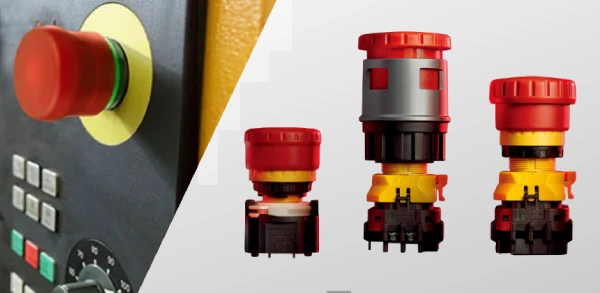
ISO sets clear rules for emergency stop buttons. In 2026, emergency stop button standards: iso require that every emergency stop button stands out in both color and shape. ISO 13850 says the button must be mushroom shaped. The color must be red, and the background should be yellow. This makes the button easy to spot during an emergency. Workers can find and press the button quickly, even when stress is high.
| Requirement | Specification |
|---|---|
| Shape | Mushroom shaped |
| Color | Red |
| Background Color | Yellow |
These design standards help prevent confusion. The bright red color signals danger or hazard. The yellow background draws attention. ISO 13850 also supports machine safety by making sure the emergency stop function is always clear. When a worker sees a mushroom-shaped red button on a yellow background, he knows it is for emergencies.
IEC & UL Requirements: Markings & Visual Features
IEC and UL standards add more requirements for emergency stop buttons. IEC 60204-1 and IEC/EN 60947-5-5 say the button must be easy to identify and separate from other controls. UL regulations agree. The button must be large, usually 40mm in diameter, and mushroom shaped. It must be red, which is the standard color for emergency stop buttons. The button must work in harsh environments, like factories with dust, water, or vibration. It must stay visible and functional in temperatures from -40°C to 70°C.
- The emergency stop button is designed with a prominent mushroom shape.
- It is colored red for high visibility.
- The button resists impact, dust, water, and vibration.
- It operates in extreme temperatures.
These requirements make sure the emergency stop system works in any emergency. The button stands out from other controls. Workers can find it fast, even in low light or noisy conditions. The standards also require clear markings. Labels or engravings help identify the emergency stop function. This supports safety and reduces mistakes.
| Standard | Requirement |
|---|---|
| NFPA 79 (2015) | Emergency stop actuators must be colored RED with a YELLOW background. |
| EN/IEC 60204 (2006) | Emergency stop actuators must be colored RED with a YELLOW background. |
| EN/ISO 13850 (2014) | Emergency stop actuators must be colored RED, with a YELLOW background where practicable. |
| Machinery Directive 2006/42/EC | Control devices must be clearly visible and identifiable. |
Linkwell Mushroom Push Button: Compliance & Features
Linkwell’s Mushroom Push Button meets all emergency stop button requirements. It follows ISO 13850, IEC 60947-5-1, and UL 508 standards. The button is mushroom shaped and colored red with a yellow background. It is easy to spot and press in an emergency. Linkwell designs the button for high performance and safety. The large actuator works well for gloved hands. The button stays visible in low light. It resists dust, water, and vibration. Workers can rely on it in harsh environments.
| Standard | Compliance Status |
|---|---|
| ISO 13850 | Compliant |
| IEC 60947-5-1 | Compliant |
| UL 508 | Compliant |
Linkwell offers customization. Users can choose cap colors, LED illumination, and labeling. The button fits many machines and control panels. It supports international regulations and safety standards. The robust construction ensures long-term reliability. Linkwell’s emergency stop buttons help protect workers and equipment. They make sure the emergency stop system works every time.
Tip: When choosing emergency stop buttons, look for clear colors, mushroom shape, and strong construction. These features support safety and compliance with international standards.
Installation & Accessibility Requirements
ISO & IEC Standards: Mounting & Location
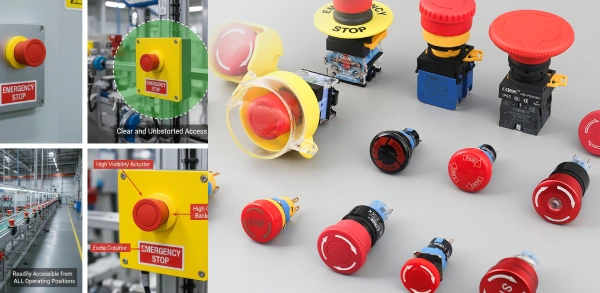
ISO and IEC standards make sure emergency stop buttons stay easy to reach in every emergency. They require that each button sits at operator stations and remains accessible from all hazard zones. Workers should never have to reach over moving parts to press the button. The standards also say the button must be clearly marked and color-coded. The height matters, too. Emergency stop buttons should be between 0.6 meters and 1.7 meters from the ground. This range fits most operators and helps everyone act fast during an emergency.
| Requirement | Description |
|---|---|
| Location | Must be at operator stations and accessible from all hazard zones. |
| Reach | Should not require reaching over moving parts. |
| Marking | Must be clearly marked and color-coded (red button on a yellow background). |
| Height | Positioned between 0.6 m to 1.7 m from the ground, depending on operator height. |
IEC 60204-1 also covers accessibility. The standards say emergency stop buttons must not use confusing indicators. For example, white arrows are not allowed. Red arrows can show the unlocking direction, but only if they do not cause mistakes. These rules help keep machine safety simple and clear.
UL Standards: Environmental Protection & IP Ratings
UL standards focus on how emergency stop buttons handle tough environments. The requirements say the enclosure must have an IP65 or NEMA 4/4X rating. This means the button resists dust and water, so it works indoors and outdoors. The safety standards also require double insulation for extra protection. These features keep the emergency stop button working during emergencies, even in factories with dust, water, or vibration.
| Feature | Description |
|---|---|
| Enclosure Rating | IP65 / NEMA 4 / 4X for dustproof and waterproof protection, perfect for harsh indoor/outdoor use. |
| Safety Standards | Complies with UL and CSA safety certifications; often features double insulation for extra protection. |
Linkwell Push Button Switch: Integration & Durability
Linkwell’s Push Button Switch and Start and Stop Push Button make installation simple. They fit easily into control panels and operator stations. The panel-mount design gives operators quick access in any emergency. These emergency stop buttons come in momentary and maintained types, so they work for many emergency stop button requirements.
Linkwell builds these buttons to last. The impact-resistant design and long-life mechanism support reliable performance. The high IP ratings mean the buttons handle dust, water, and vibration without trouble. This durability meets international regulations and safety standards. Linkwell’s emergency stop buttons adapt to harsh environments and support machine safety everywhere.
| Feature | Description |
|---|---|
| Types | Momentary, maintained |
| Performance | Reliable control operation with quick response |
| Durability | Impact-resistant, long-life mechanism |
| Integration | Panel-mounted for easy operator access |
Tip: Choose emergency stop buttons that meet all emergency stop button standards: iso, IEC 60204-1, and UL. This ensures safety, compliance, and smooth operation in every emergency.
Operational & Performance Requirements
ISO Emergency Stop Buttons: Stop Categories & Reset
ISO emergency stop button standards: iso focus on making emergency stop buttons both effective and easy to use. The requirements ensure that every emergency stop button stands out and works reliably in any emergency. ISO 13850 sets clear rules for color, accessibility, latching, and reset functions. The button must be red with a yellow background, so workers can spot it quickly. It must always be within reach and never blocked by equipment or barriers. When pressed, the button must latch mechanically and require a manual reset before restarting the machine. This prevents accidental restarts and keeps everyone safe. The emergency stop function must stop hazardous motion as fast as possible, but without creating new risks. ISO also requires that emergency stop buttons meet at least Performance Level c (PL c) based on a risk assessment. This ensures the emergency stop system delivers reliable safety functions in every situation.
| Requirement | Description |
|---|---|
| Color | Red with a yellow background |
| Accessibility | Readily accessible and unobstructed |
| Latching | Must latch mechanically and require manual reset before restarting |
| Stopping Motion | Must stop hazardous motion as quickly as possible without creating new risks |
| Performance Level | Must meet at least PL c as defined by risk assessment |
ISO 13850:2015 also highlights the importance of fail-safe operation. Emergency stop buttons must be easy to identify and operate rapidly. These design principles help prevent accidents and support machine safety in busy industrial environments.
- ISO 13850:2015 outlines principles for the design of emergency stop functions.
- Emergency stop buttons must be easily identifiable.
- The design ensures rapid operation in emergencies.
IEC & UL Standards: Electrical Ratings & Reliability
IEC and UL standards set strict requirements for the electrical performance and reliability of emergency stop buttons. These standards help ensure that emergency stop buttons work every time, even in tough industrial settings. Most industrial applications require emergency stop circuits to meet Performance Level d (PLd), which means the system uses a dual-channel design and achieves over 90% diagnostic coverage. This high level of reliability is essential for safety-critical applications.
- Emergency stop circuits must meet performance levels from PLc to PLe, with PLd as the standard for most industries.
- PLd requires a dual-channel architecture and high diagnostic coverage.
- Reliability is measured by Performance Level (PL) and Safety Integrity Level (SIL), both determined by risk assessments.
- Emergency stop buttons must be red mushroom-head or rope-pull types, with a minimum IP65 environmental rating.
The IEC 60947-5-5 standard adds even more confidence. It requires emergency stop devices to function reliably in challenging conditions, such as dust, moisture, or vibration. UL certification further confirms that these devices meet international safety standards and deliver consistent performance in industrial automation. These requirements make sure the emergency stop button system protects workers and equipment, no matter the environment.
Linkwell Start and Stop Push Button: Safety & Efficiency
Linkwell’s Start and Stop Push Button stands out in safety-critical applications. The design supports fail-safe operation and reliable performance, meeting all major international standards. Linkwell’s emergency stop buttons carry certifications from UL, CE, IECEx, ATEX, and ISO 9001. These certifications show that the buttons meet strict requirements for safety, quality, and use in hazardous environments.
| Certification | Description |
|---|---|
| UL | Underwriters Laboratories certification for safety standards |
| CE | Conformité Européenne marking indicating compliance with EU safety standards |
| IECEx | International Electrotechnical Commission certification for explosive areas |
| ATEX | EU directive for equipment in explosive atmospheres |
| ISO 9001 | International standard for quality management systems |
Linkwell’s emergency stop buttons use robust materials and advanced engineering. The large, red mushroom head ensures quick identification and operation, even with gloves. The buttons latch securely when pressed and require a manual reset, preventing accidental restarts. High IP ratings protect the buttons from dust and water, so they work reliably in harsh environments. The dual-channel design and high diagnostic coverage meet the latest safety functions and machine safety requirements.
Operators trust Linkwell’s emergency stop buttons for their proven performance and compliance with international standards. The buttons help reduce hazard risks and support a safer workplace. Linkwell’s commitment to quality and innovation ensures that every emergency stop button delivers the safety and efficiency needed in modern industrial settings.
Note: Choosing emergency stop buttons with the right certifications and robust design helps companies meet emergency stop button requirements and maintain compliance with global safety standards.
Compliance with International Standards & Maintenance
Integration: Safety Circuits & Interlocks
Emergency stop buttons play a key role in safety circuits and interlocks. Operators need easy access from any position. The red actuator on a yellow background stands out, following emergency stop button standards: iso. When pressed, the button stays engaged until someone resets it manually. Automatic resets are not allowed. Emergency stop buttons override all other controls except for emergency power disconnect. Mechanical action breaks the contacts directly, so safety does not depend only on electronics.
Safety circuits must work even if one part fails. Redundant circuits get monitored for faults. Safety-rated contactors or relays with linked contacts help prevent single points of failure. Wire sizing and protection matter. Regular testing protocols keep emergency stop buttons reliable. Reset procedures require a deliberate action. A dedicated reset button prepares the circuit for normal operation but does not restart the machine.
| Regulation/Standard | Key Points |
|---|---|
| PUWER | Protective devices and control systems, including emergency stop buttons, ensure safety in machinery. |
| ISO 14119 | Principles for interlocking devices, including emergency stop functions. |
| ISO 12100 | Guidelines for risk assessment and reduction, helping decide when interlocks and emergency stops are needed. |
Documentation & Testing: Inspection Guidelines
Proper documentation and regular testing help maintain emergency stop buttons. International standards recommend periodic inspections. Safety experts suggest testing emergency stop buttons at least once a month. NFPA 79 and PUWER 98 say testing can range from monthly to yearly, depending on the environment.
| Source | Recommendation |
|---|---|
| NFPA 79 & PUWER 98 | Test emergency stop buttons periodically, from once a month to once a year. |
Operators should keep records of each inspection. Maintenance teams check visibility, secure mounting, correct wiring, and working condition. Scheduled maintenance ensures emergency stop buttons stay ready for any emergency.
- Conduct regular checks and maintenance.
- Test emergency stop buttons at least twice a year, or more often in harsh environments.
- Seek professional help for wiring or installation if needed.
Linkwell Solutions: Global Compliance & Support
Linkwell commits to compliance with international standards. The company holds TUV certifications and offers global support. Linkwell recommends best practices for emergency stop button maintenance and documentation.
| Step | Done? |
|---|---|
| Location is visible | ☐ |
| Switch is mounted securely | ☐ |
| Wiring is correct | ☐ |
| Button tested and working | ☐ |
| Maintenance scheduled | ☐ |
Linkwell’s team helps clients meet emergency stop button requirements. They provide guidance on installation, maintenance, and testing protocols. Linkwell’s emergency stop buttons deliver reliable safety and support machine safety in every emergency.
Tip: Keeping emergency stop buttons in top condition protects workers and ensures compliance with safety standards.
Conclusion
Emergency stop buttons keep workers safe and help companies meet strict rules. ISO, IEC, and UL standards in 2026 set clear requirements for design, installation, operation, and maintenance. These standards make sure emergency stop buttons stand out, work fast, and stay reliable in every situation.
Companies that follow these standards protect their teams and gain access to global markets. Linkwell offers certified mushroom push buttons and start-stop switches that meet ISO 13850, IEC 60947-5-1, and UL 508. Their products feature high visibility, robust construction, and easy integration. Linkwell’s commitment to quality and compliance gives buyers peace of mind.
Here’s a quick checklist for staying compliant and safe:
- Choose emergency stop buttons with red mushroom heads and yellow backgrounds.
- Make sure buttons are easy to reach and operate.
- Install buttons with high IP ratings for dust and water resistance.
- Use products with certifications like UL, CE, and TUV.
- Schedule regular inspections and keep records.
- Train workers to recognize and use emergency stop buttons.
Tip: Companies can boost safety and avoid legal trouble by picking certified products and following maintenance routines.
| Step | Action Needed |
|---|---|
| Product Selection | Use certified buttons |
| Installation | Follow height/location rules |
| Inspection | Test and document regularly |
| Training | Teach proper use |
Linkwell stands out as a trusted partner for cabinet components and safety solutions. Their global support and customization options help companies meet every requirement. For more information or to explore Linkwell’s emergency stop solutions, visit Linkwell Electrics.
Safety starts with the right emergency stop button. Companies that invest in quality and compliance build safer workplaces and stronger reputations.
Meeting ISO, IEC, and UL standards for emergency stop buttons keeps workers safe and helps companies avoid legal trouble. These standards require clear design, reliable operation, and proper installation. Compliance builds trust and opens doors to global markets.
- UL-certified components protect people and reduce system failures.
- Regular testing and inspections keep emergency stop buttons ready.
- Accurate records show that companies follow safety rules.
- Choosing certified products like Linkwell’s ensures peace of mind.
Staying compliant means safer workplaces and stronger reputations.
FAQ
What color should an emergency stop button be in 2026?
Emergency stop buttons must be red with a yellow background. This color combination helps workers spot the button quickly during emergencies. ISO, IEC, and UL standards all require this design for safety.
How often should companies test emergency stop buttons?
Safety experts recommend testing emergency stop buttons at least twice a year. Factories with harsh environments may need more frequent checks. Regular testing keeps the system reliable and ready for emergencies.
Do Linkwell emergency stop buttons meet international standards?
Linkwell designs emergency stop buttons to meet ISO 13850, IEC 60947-5-1, and UL 508 standards. These products carry certifications like UL, CE, and TUV. Companies trust Linkwell for global compliance and reliable performance.
Can emergency stop buttons be customized for different machines?
Yes, Linkwell offers customization options. Users can choose cap colors, LED illumination, and labeling. Customization helps operators identify functions and improves safety in complex control panels.
Why is the mushroom shape important for emergency stop buttons?
The mushroom shape makes the button easy to press, even with gloves. It stands out from other controls. Workers can activate the emergency stop quickly, reducing risks and improving safety.