You can figure out creepage and clearance distances for terminal blocks in a few simple steps. First, check the voltage rating, pollution degree, and material group for your project. Next, look up the required distances in international standards like IEC or UL. In clean air, creepage is about 15 millimeters per kilovolt, but it increases with pollution. Always measure the actual distances on your terminal blocks. Linkwell’s certified products, built for high-voltage and harsh environments, help you meet these requirements. This hands-on approach makes Understanding Creepage and Clearance Distances in Terminal Block Design much easier.
Key Takeaways
- Always check your system’s voltage, pollution degree, and material group before starting your terminal block design.
- Use international standards like IEC and UL to find the required creepage and clearance distances for safety.
- Measure both creepage and clearance distances accurately using a ruler or caliper to ensure compliance.
- Choose certified Linkwell terminal blocks to guarantee reliable performance in high-voltage and harsh environments.
- Plan early to avoid costly mistakes and ensure smooth inspections by verifying creepage and clearance requirements.
Understanding Creepage and Clearance in Terminal Block Design
What is Creepage Distance?
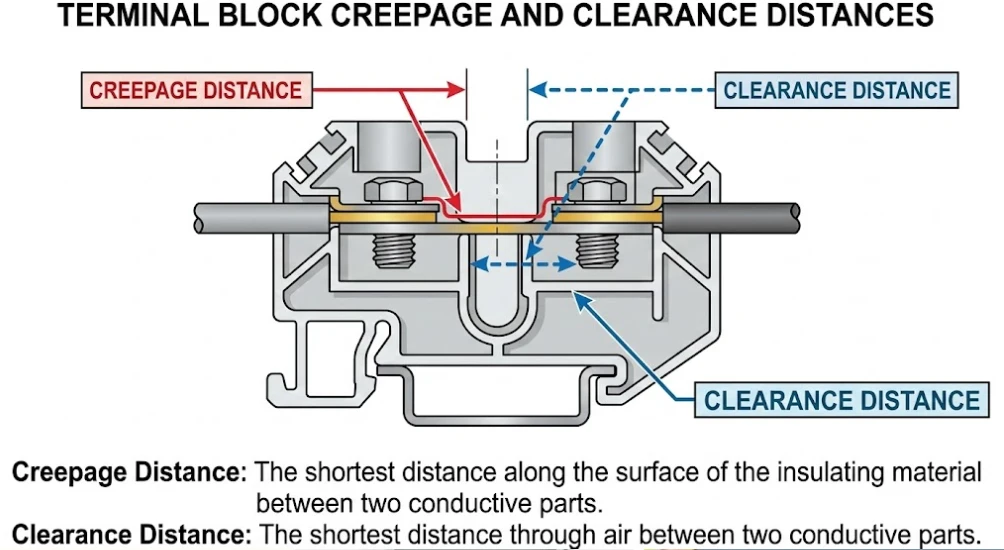
When you start understanding creepage and clearance distances in terminal block design, you’ll notice that creepage distance comes up a lot. Creepage distance is the shortest path between two conductive parts, but it travels along the surface of the insulating material. This distance matters most when you deal with dust, moisture, or pollution, because these conditions can cause electrical tracking along the surface. The longer the creepage distance, the better your protection against unwanted current paths.
Here’s a quick table to help you see the difference between creepage and clearance:
| Term | Definition |
|---|---|
| Clearance distance | Shortest separation in the air between two conducting parts |
| Creepage distance | Shortest separation along the surface of insulating material between two conducting parts |
What is Clearance Distance?
Clearance distance is the shortest straight-line gap through the air between two conductive parts. You need to pay attention to this when you want to prevent sparks or arcing, especially during voltage spikes. If you work in high-voltage or polluted environments, you must make sure your terminal blocks have enough clearance to keep everything safe.
Why These Distances Matter for Linkwell Terminal Blocks
Understanding creepage and clearance distances in terminal block design is not just about following rules. These distances protect you from electrical hazards and keep your equipment running smoothly. Here’s why they matter:
- Creepage and clearance help prevent arcing and electrical tracking, which can cause equipment failure or even injuries.
- High-voltage applications and polluted environments need larger creepage and clearance values for safety.
- Meeting the right distances ensures your terminal blocks comply with international standards like IEC, UL, and CE.
Linkwell terminal blocks are designed with these requirements in mind. You get products that use high dielectric strength insulation and robust contact materials. Linkwell’s certifications, including UL, CE, RoHS, and IEC, show that you can trust their products for reliable performance. When you focus on understanding creepage and clearance distances in terminal block design, you make your projects safer and more dependable.
Tip: Always check the rated impulse voltage and pollution degree for your application. This helps you pick the right terminal block and avoid costly mistakes.
Understanding creepage and clearance distances in terminal block design gives you the confidence to choose the right products and keep your systems safe.
Calculating Creepage and Clearance Distances
Identifying Relevant Standards (IEC, UL, etc.)
You need to start with the right standards. International standards like IEC 60947, IEC 60664, and UL 1059 set the rules for creepage and clearance in terminal block design. These standards tell you how to measure, what values to use, and how to check compliance. Linkwell terminal blocks meet UL, CE, RoHS, and IEC requirements, so you can trust their products for safe and reliable connections.
If you work in different regions or industries, check which standard applies. IEC standards are common in Europe and Asia. UL standards are popular in North America. Always match your project to the correct standard before you begin calculations.
Tip: Look for certification marks on Linkwell terminal blocks. These marks show that the product meets the required standards for creepage and clearance.
Determining Voltage, Pollution Degree, and Material Group
You need to know your system’s voltage, pollution degree, and material group. These factors affect the minimum creepage distance and clearance distance you need.
- Voltage rating: Higher voltages require larger creepage and clearance values.
- Pollution degree: This describes how dirty or contaminated the environment is. Pollution degree ranges from 1 (clean, dry) to 4 (heavy pollution). More pollution means you need bigger distances.
- Material group: Insulating materials are grouped by their Comparative Tracking Index (CTI). The CTI tells you how well the material resists electrical tracking.
Here’s a quick look at material groups:
| Material Group | CTI Range |
|---|---|
| Group I | 600 ≤ CTI |
| Group II | 400 ≤ CTI < 600 |
| Group IIIa | 175 ≤ CTI < 400 |
| Group IIIb | 100 ≤ CTI < 175 |
You also need to consider overvoltage category and environmental factors like humidity and contamination. Humidity can cause condensation, which affects insulation. Contamination can bridge small gaps and reduce safety.
- Operating and rated voltage
- Type of insulation and material group
- Pollution degree of the environment
- Overvoltage category
- Temperature and humidity
A higher pollution degree or overvoltage category means you need larger creepage and clearance values. Understanding these factors helps you pick the right Linkwell terminal block for your project.
Using Standard Tables for Required Distances
Once you know your voltage, pollution degree, and material group, you can use standard tables to find the required creepage and clearance values. These tables are found in IEC and UL standards. They list minimum distances for different conditions.
Let’s look at a sample table for high-voltage and low-voltage terminal blocks:
| Insulation Type | Clearance (Min.) | Creepage Distance (Min., Material Group IIIa) |
|---|---|---|
| Basic Insulation | 2.0 mm | 3.2 mm |
| Reinforced Insulation | 4.0 mm | 6.4 mm |
If you use a material from Group I, you can use smaller creepage distances. If you use Group IIIb, you need larger distances. Pollution degree and voltage also change the values. Always check the tables in the standard that matches your project.
Note: Linkwell terminal blocks use flame-retardant materials and high CTI ratings. This helps you meet stricter requirements for creepage and clearance.
Measuring and Comparing on Linkwell Terminal Blocks
After you find the required values, measure the actual creepage and clearance on your terminal blocks. Use a ruler or caliper to check the shortest path along the surface for creepage distance. For clearance, measure the straight-line gap through the air.
- Measure creepage and clearance on the terminal block.
- Compare your measurements to the values from the standard tables.
- Make sure your terminal block meets or exceeds the minimum requirements.
Linkwell terminal blocks are designed for easy measurement. Their modular design and clear labeling help you check distances quickly. If you need to handle high current or harsh environments, Linkwell’s certified products give you extra safety.
Callout: Always measure both creepage and clearance. Environmental factors like humidity and contamination can affect your results. Linkwell terminal blocks are built to handle these challenges.
If you follow these steps, you can calculate creepage and clearance distances with confidence. You make your electrical system safer and more reliable.
Common Mistakes and Practical Tips
Frequent Errors in Calculation
You might think measuring creepage and clearance is simple, but small mistakes can lead to big problems. Many people confuse creepage distance with clearance distance. They measure only the straight line through air and forget to check the path along the surface. Sometimes, they use the wrong pollution degree or material group. This can make the calculated values too low for the real environment. Skipping the step of checking the actual distances on the terminal block is another common error. If you only trust the datasheet and never measure, you might miss small design changes that affect safety.
Tips for Accurate Measurement with Linkwell Products
You can avoid most mistakes by following a few practical tips. Always use a precise ruler or caliper to measure the shortest path for creepage distance. For clearance distance, measure the direct gap through air. Linkwell’s modular terminal blocks make this process easier because you can separate and inspect each section. Their clear markings help you find the right points to measure. If you work in special environments, you need to adjust your approach. Here’s a quick table with design tips for tricky situations:
| Situation | Design Tip |
|---|---|
| High Humidity | Use conformal coating or increase creepage distance |
| Tight PCB Space | Add slots or ridges to increase surface path |
| High Altitude | Apply clearance correction factor (~1.5× at 5000m) |
| High-Frequency Switching | Add extra margin for EMI control |
Tip: Always double-check your measurements after installation. Even a small change in mounting can affect the minimum creepage distance.
Design Adjustments for Compliance
You can make simple design changes to meet creepage and clearance requirements. Choose terminal blocks with higher CTI materials for better tracking resistance. Add barriers or slots to increase the surface path if space is tight. For high-voltage or polluted environments, select Linkwell terminal blocks with reinforced insulation. These adjustments help you meet international standards and keep your system safe. When you focus on these details, you avoid costly redesigns and ensure long-term reliability.
Example Calculation for Linkwell Terminal Blocks
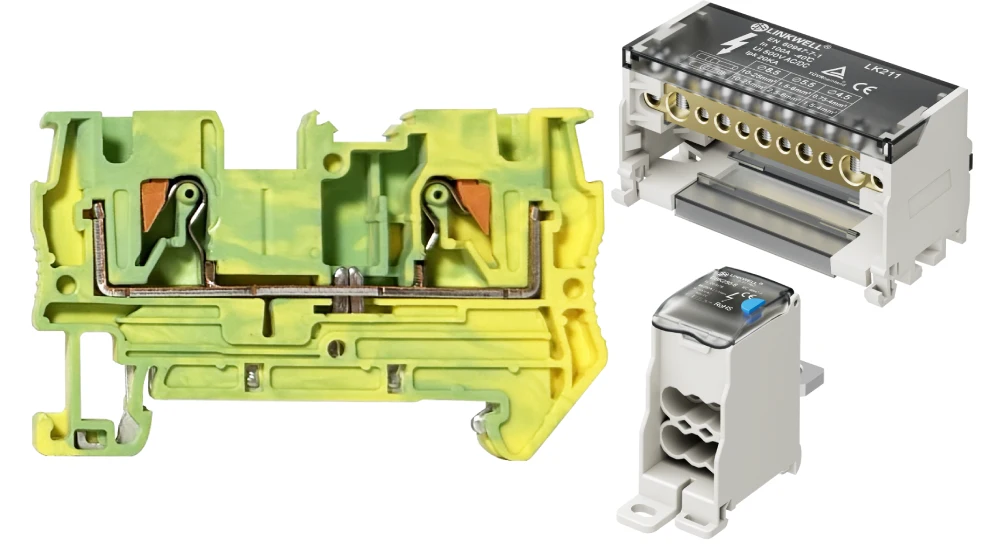
Sample Scenario and Parameters
Let’s walk through a real example. You need to select a terminal block for a control panel that runs at 400 V AC. The environment is an industrial workshop with moderate dust, so you set the pollution degree to 2. The insulation material is Group II, which means the CTI is between 400 and 600. You choose a Linkwell LDB160 terminal block, which handles up to 160 A and uses flame-retardant housing.
Here’s a quick summary:
| Parameter | Value |
|---|---|
| Voltage | 400 V AC |
| Pollution Degree | 2 |
| Material Group | II (CTI 400–600) |
| Terminal Block | Linkwell LDB160 |
Applying the Calculation Steps
You start by checking the IEC 60664-1 standard. For 400 V, pollution degree 2, and material group II, the table says you need at least 3 mm clearance and 5.6 mm creepage distance. You grab a caliper and measure the shortest air gap (clearance) on the LDB160. It’s 4 mm. Then you measure the creepage path along the surface. It’s 7 mm. Both values are above the minimum.
Tip: Always measure both paths, not just one. This helps you avoid surprises during inspection.
Ensuring Compliance with Standards
You want to make sure your panel meets IEC and UL rules. Here’s how you do it:
- Check the Short-Circuit Current Rating (SCCR) for each component, including your Linkwell terminal block.
- See if your feeder-circuit protective devices can lower the fault current downstream.
- Find the lowest SCCR among all parts. That’s your panel’s overall SCCR.
- Mark this SCCR value on your control panel’s nameplate.
By following these steps, you confirm that your creepage and clearance distances meet the standards. You also make sure your panel is safe and ready for inspection. When you use Linkwell terminal blocks, you get products that are easy to measure and designed for compliance.
Conclusion
You’ve made it to the end of your journey into creepage and clearance distances. Let’s wrap things up and make sure you’re ready to tackle your next terminal block project with confidence.
Here’s what you need to remember:
- Start with the basics. Always check your voltage rating, pollution degree, and material group before you begin.
- Use the right standards. IEC and UL standards give you the minimum distances you need for safety.
- Measure twice, install once. Grab your ruler or caliper and check both creepage and clearance on your terminal blocks.
- Choose certified products. Linkwell terminal blocks meet UL, CE, RoHS, and IEC standards. You get peace of mind and reliable performance.
Tip: Don’t wait until the last minute to check creepage and clearance. If you plan early, you avoid costly redesigns and keep your project on track.
You can make your electrical systems safer and more efficient by following these steps. When you use Linkwell terminal blocks, you get products designed for easy measurement and compliance. Their modular design and clear labeling help you stay organized and accurate.
If you ever feel stuck or need a custom solution, reach out to Linkwell’s technical support. You’ll get expert advice and fast answers. You can find more information and contact details on Linkwell’s official website.
Here’s a quick checklist for your next project:
| Step | Action |
|---|---|
| 1. Identify specs | Voltage, pollution, material |
| 2. Check standards | IEC, UL, CE, RoHS |
| 3. Measure | Creepage and clearance |
| 4. Compare | Against standard tables |
| 5. Choose | Certified Linkwell products |
| 6. Consult | Linkwell technical support |
You can make your terminal block design safer by following these steps:
- Find your system voltage.
- Check the pollution degree in your environment.
- Pick the right material group using the CTI value.
- Use standard tables like IEC 60664-1 for minimum distances.
| Why Start Early? | What It Means for You |
|---|---|
| Meets safety standards | Keeps your project safe and reliable |
| Prevents arcing and faults | Avoids costly mistakes |
| Ensures smooth inspections | Saves time and effort |
Choose certified Linkwell products for peace of mind. If you need help, reach out to Linkwell’s technical support for custom solutions.
FAQ
What is the difference between creepage and clearance?
Creepage travels along the surface of insulation. Clearance goes straight through the air. You need both to keep your terminal blocks safe from electrical faults.
How do I measure creepage and clearance on a terminal block?
Grab a ruler or caliper. Measure creepage along the surface between conductors. Measure clearance as the shortest air gap. Always check both paths.
Why do pollution degree and material group matter?
Pollution degree tells you how dirty the environment is. Material group shows how well insulation resists electrical tracking. Both affect the minimum distances you need.
Can I use Linkwell terminal blocks for high-voltage projects?
Yes! Linkwell terminal blocks meet UL, CE, RoHS, and IEC standards. You get reliable performance for high-voltage and harsh environments.
Where can I find technical support for Linkwell products?
You can reach Linkwell’s technical team by phone, email, or through their official website. They help you with custom solutions and fast answers.