UL 1059 vs IEC 60947: Terminal Block Standards Comparison
Share this:
Table of Contents
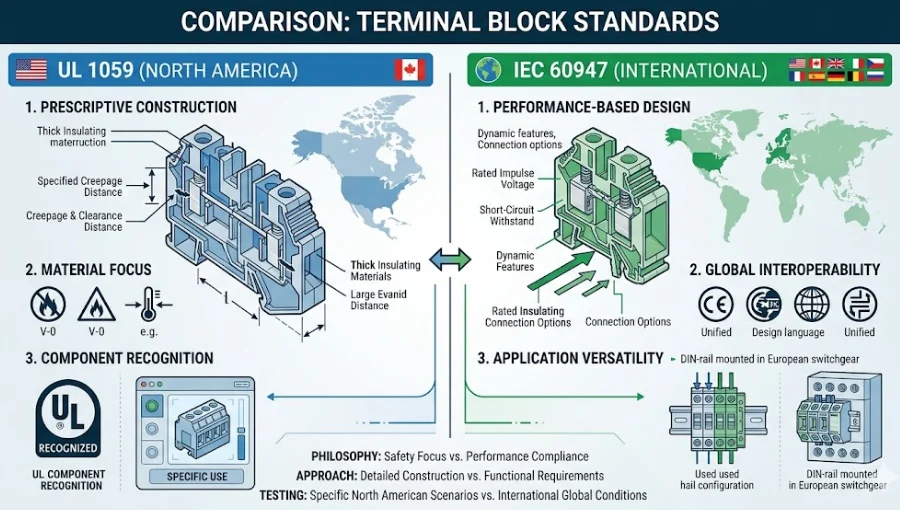
The main difference between UL 1059 and IEC 60947 is that UL 1059 focuses on safety and quality for North America, while IEC 60947 covers design and performance for international use. If you’re an engineer, a buyer, or a panel builder, you know that choosing the right standard for terminal blocks can make or break your project.
These standards protect users and equipment, and they open doors to new markets by ensuring compliance. The terminal block market is growing fast, driven by strict regulations like UL 1059 and IEC 60947 that boost reliability and safety. Linkwell offers terminal blocks certified to both standards, making global projects simple.
If you want a quick answer to UL 1059 vs IEC 60947: Terminal Block Standards Comparison, it’s all about matching your needs to the right certification.
Key Takeaways
Understand the difference: UL 1059 focuses on safety for North America, while IEC 60947 emphasizes performance for global use.
Choose the right standard based on your project location: Use UL 1059 for North America and IEC 60947 for Europe and beyond.
Select dual-certified terminal blocks from Linkwell to simplify compliance and ensure safety in international projects.
Always check certification markings on terminal blocks to confirm they meet safety and performance standards.
Consider application needs: UL 1059 is ideal for control panels, while IEC 60947 suits power distribution and automation.
UL 1059 Standard Overview
What is UL 1059?
UL 1059 is a safety standard created by Underwriters Laboratories (UL), a well-known organization in the United States. This standard sets the rules for how terminal blocks should be built and tested to keep electrical systems safe. If you work with control panels or power distribution, you probably see UL 1059 on many products. The main goal is to make sure every terminal block can handle real-world conditions without causing hazards like fires or electric shocks.
Scope and Application for Terminal Blocks
UL 1059 covers terminal blocks used in a wide range of electrical equipment. You’ll find these blocks in control cabinets, industrial machines, and even commercial electronics. The standard applies to both screw and spring clamp types. It looks at how terminal blocks connect wires, how much current they can carry, and how well they protect users from accidental contact. If you need to meet North American safety codes, UL 1059 is the go-to standard. Linkwell offers a full line of UL-certified terminal blocks, so you can trust their products for your next project.
Key Safety and Quality Testing
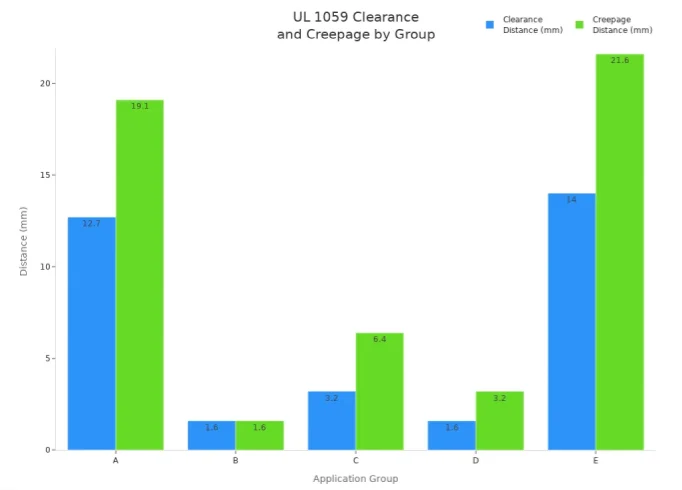
UL 1059 requires several important tests to make sure terminal blocks are safe and reliable. These tests check things like insulation, temperature rise, and how much current the block can handle. The standard also sets rules for creepage and clearance distances, which help prevent short circuits and arcing. Here’s a quick look at how UL 1059 groups applications and what each group must pass:
Application Group
Explanation
Max. Nominal Voltage (V)
Clearance (mm)
Creepage Distance (mm)
A
Control elements, consoles, etc.
150-300-600
12.7-19.1-25.4
19.1-31.8-50.8
B
Commercial equipment, including office and electronic data processing equipment
150-300-600
1.6-2.4-5.0
1.6-4.2-12.7
C
All devices and equipment for industrial applications
150-300-600
3.2-4.9-5.0
6.4-9.5-12.7
D
All devices and equipment for industrial applications with limited current data
300-600
1.6-4.8
3.2-9.5
E
Connection technology for the power range 600 V … 1500 V
601 – 1000, 1001 – 1500
14-17.8
21.6-30.5
F
Industrial applications, equipment rated to UL 508, 508 C, 840
51 – 1500
As specified in the device standard
As defined in the device standard
Tip: Choosing UL-certified terminal blocks from Linkwell means your project will pass these tests and meet strict safety codes.
IEC 60947 Standard Overview
What is IEC 60947?
IEC 60947 is a global standard from the International Electrotechnical Commission. This standard sets the rules for low-voltage switchgear and controlgear, including terminal blocks. The main goal is to make sure every terminal block works safely and reliably in electrical systems around the world. IEC 60947 focuses on how products perform and how they are designed, not just on safety. This means engineers and panel builders can trust that their equipment will work well in many different countries.
Applies to circuit breakers with main contacts intended for circuits.
Rated Voltage
Does not exceed 1000 V a.c. or 1500 V d.c.
Additional Requirements
Includes requirements for integrally fused circuit-breakers, earth-leakage protection, electronic overcurrent protection, and electromagnetic compatibility.
Scope for Terminal Blocks
IEC 60947 includes rules for many types of terminal blocks. It covers both feed-through and ground terminal blocks, which are used in control panels, power distribution, and automation. The standard looks at how these blocks connect wires, how much current they can handle, and how they protect users. Linkwell offers a wide range of IEC-certified terminal blocks, including ground terminal blocks with green-yellow housings for safety. These products help you meet international codes and pass every test required for global projects.
Key Performance and Design Criteria
IEC 60947 sets strict performance and design rules for terminal blocks. The standard requires each block to pass several tests, such as temperature rise, dielectric strength, and short-circuit withstand. It also checks creepage and clearance distances to prevent arcing. Every test makes sure the terminal block will last and stay safe, even in tough environments. Linkwell’s terminal blocks are designed to meet all these requirements. Their ground terminal blocks are tested for high fault currents and meet the latest IEC standards. When you choose Linkwell, you get terminal blocks that pass every test and keep your system running smoothly.
UL 1059 vs IEC 60947: Terminal Block Standards Comparison
Basic Differences and Similarities
Let’s break down the ul 1059 vs iec 60947: terminal block standards comparison in a way that’s easy to follow. Both standards help keep electrical systems safe, but they come from different places. UL 1059 is mostly used in North America. IEC 60947 is recognized worldwide. UL focuses more on safety and quality. IEC looks at how well a terminal block performs and how it is designed.
Both standards want to make sure terminal blocks do not fail. They both require a test for things like temperature rise and insulation. You will see both standards on Linkwell terminal blocks. This means you can use them in many countries without worry.
Here’s a quick table to show the main points:
Feature
UL 1059 (North America)
IEC 60947 (International)
Focus
Safety and quality
Performance and design
Issuing Body
Underwriters Laboratories (UL)
International Electrotechnical Commission (IEC)
Main Use
USA, Canada, Mexico
Europe, Asia, global markets
Application Grouping
Yes, by equipment type
Yes, by function and rating
Product Example
Linkwell UL-certified terminal blocks
Linkwell IEC-certified terminal blocks and ground terminal blocks
Note: If you need to ship your panels worldwide, Linkwell’s dual-certified terminal blocks make things simple.
Electrical Ratings and Testing
Now, let’s talk about how each terminal block standard handles ratings and testing. UL 1059 uses strict rules for voltage, current, and temperature. Every terminal block must pass a test for insulation, creepage, and clearance. The standard also checks how much heat builds up when current flows through the block.
IEC 60947 also requires a test for temperature rise, dielectric strength, and short-circuit withstand. It looks at how the block performs under stress. Both standards want to see that the block will not fail during normal use or even in tough conditions.
Here’s a side-by-side look at the ul 1059 vs iec 60947: terminal block standards comparison for ratings and testing:
Criteria
UL 1059
IEC 60947
Voltage Rating
Up to 1500 V (grouped by application)
Up to 1000 V AC / 1500 V DC
Current Rating
Based on wire size and test results
Based on design and test results
Temperature Test
Yes, must pass
Yes, must pass
Short-Circuit Test
Required for some types
Required for all
Product Example
Linkwell LDB Series terminal blocks
Linkwell ground terminal blocks
If you want a block that passes every test, Linkwell has you covered. Their terminal blocks meet both standards, so you get peace of mind.
Marking and Identification
Marking is important. It tells you what the terminal block can do and where you can use it. UL 1059 requires clear markings for voltage, current, and wire size. You will see the UL mark on every certified block. This helps inspectors and users know the block meets the right standard.
IEC 60947 also needs clear markings. It asks for the IEC symbol, ratings, and sometimes color codes. For example, ground terminal blocks often use green-yellow for safety. Linkwell’s terminal blocks show both UL and IEC marks, making them easy to identify.
Here’s a quick ul 1059 vs iec 60947: terminal block standards comparison for marking:
Marking Requirement
UL 1059
IEC 60947
Certification Mark
UL logo
IEC symbol
Ratings Shown
Voltage, current, wire size
Voltage, current, function
Color Codes
Not required
Yes, for ground/neutral
Product Example
Linkwell screw terminal blocks
Linkwell ground terminal blocks
Tip: Always check the markings before you install a terminal block. This keeps your project safe and compliant.
Application Areas
Where do you use each standard? UL 1059 is the top choice for projects in the United States, Canada, and Mexico. It is often required for control panels, industrial machines, and commercial equipment. IEC 60947 is the go-to for Europe, Asia, and other global markets. It is used in power distribution, automation, and renewable energy.
Many companies now build panels for customers around the world. That’s why dual certification is so valuable. Linkwell’s terminal blocks are ready for any market. You can use them in wind power, solar, EV charging, and more.
Here’s a final ul 1059 vs iec 60947: terminal block standards comparison for application areas:
If you want one solution for every project, Linkwell’s dual-certified terminal blocks are a smart pick.
The ul 1059 vs iec 60947: terminal block standards comparison helps you choose the right product for your needs. Both standards protect people and equipment. Both require a test for safety and performance. With Linkwell, you get terminal blocks that meet every requirement, no matter where your project goes.
Key Technical Differences in Terminal Blocks
Creepage and Clearance
Creepage and clearance are all about safety gaps. Creepage is the shortest path along the surface between two points. Clearance is the straight-line distance through the air. Both UL 1059 and IEC 60947 set strict rules for these gaps in terminal blocks. They want to stop electricity from jumping where it shouldn’t. UL groups applications and gives exact numbers for each group. IEC uses voltage and pollution levels to set its rules. Linkwell designs every terminal block with these distances in mind. This helps each block pass every test and keeps your panel safe.
Ampacity and Temperature Rise
Ampacity means how much current a terminal block can handle. If you push too much current, the block heats up. Both standards require a temperature rise test. UL 1059 checks how hot the block gets at full load. IEC 60947 does the same but may use different test setups. Linkwell terminal blocks use high-quality copper and flame-retardant housing. This helps them stay cool and pass every ampacity test, even in tough jobs.
Torque and Wire Size
Getting the right torque is key. If you tighten too much or too little, wires can slip or break. UL 1059 and IEC 60947 both say how much torque to use for each wire size. They also require a test to make sure the connection stays strong. Linkwell terminal blocks come with clear markings for torque and wire size. This makes installation easy and helps you pass every test.
Short-Circuit Withstand
Short circuits can happen fast. Both standards want to see that terminal blocks can survive a short-circuit test. UL 1059 may require this for some types. IEC 60947 always asks for it. Linkwell tests every terminal block to make sure it can handle high fault currents. This means your system stays safe, even when things go wrong.
Tip: Always check the datasheet for creepage, ampacity, torque, and short-circuit ratings before you pick a terminal block.
Quality Testing for Terminal Blocks
UL 1059 Testing Methods
UL 1059 sets out clear rules for quality testing for terminal blocks. The main goal is to make sure every terminal block is safe and reliable. The standard asks for a test on insulation, temperature rise, and how much current the block can handle. There is also a test for creepage and clearance distances. These tests help prevent short circuits and overheating. UL also checks the strength of the wire connection by making sure the wires stay tight after being installed. If a terminal block passes all these tests, it earns the UL mark. This mark shows the block is ready for use in North America.
IEC 60947 Testing Methods
IEC 60947 uses a wide range of tests to check the safety and performance of terminal blocks. The standard looks at how well the block works under real-world conditions. Here’s a quick look at some of the main tests:
Checks for low contact resistance and stable voltage drop.
Mechanical strength of clamping units
Assesses reliability through repeated wiring tests.
Temperature rise test
Measures how hot the block gets under load.
Short-time withstand current
Tests the block’s ability to survive short-circuit conditions.
Aging test for screwless blocks
Looks at long-term reliability of screwless connections.
Clearance and creepage distances
Makes sure insulation and voltage ratings are safe.
Pull-out test
Verifies wire connections stay secure under pulling forces.
These tests make sure terminal blocks can handle tough jobs and keep working for years.
Linkwell Quality Assurance
Linkwell takes quality testing for terminal blocks seriously. Every terminal block goes through strict checks before it leaves the factory. Linkwell’s products carry international certifications like UL, CE, and TUV. This means they meet the highest standards for safety and performance. The company uses advanced machines to test for temperature rise, voltage drop, and mechanical strength. Linkwell also checks that every block meets both UL and IEC requirements. You can trust Linkwell terminal blocks to pass every test and keep your electrical systems safe.
When you choose Linkwell, you get terminal blocks that are tested, certified, and ready for any project—anywhere in the world.
Compliance and Certification for Terminal Blocks
Certification Process
Getting a terminal block certified is not just about passing one test. It’s a step-by-step journey that checks every detail. Both UL and IEC have their own paths for standards compliance. Here’s a quick look at how the process works for each:
1. Define requirements for spacing, current-carrying capacity, and insulation.
2. Conduct testing for safety and performance under specified conditions.
3. Ensure compliance with standards for DIN-rail or panel-mounted applications.
IEC 60947-7
1. Apply to terminal blocks for copper conductors with specified voltage and frequency limits.
2. Test for connection capabilities of round copper conductors within the defined cross-section range.
3. Verify compliance with low-voltage switchgear and control gear requirements.
Manufacturers send their terminal blocks to a certified lab. The lab will test for things like temperature rise, insulation, and short-circuit withstand. If the block passes every test, it gets the official mark. This mark shows the block meets all standards compliance rules.
Manufacturer and User Implications
For manufacturers, following these standards means designing products that pass every test. They must keep records and update designs if the rules change. For users, certified terminal blocks make life easier. You know the block will work safely in your panel. Inspectors also look for these marks during approval. This helps projects move forward without delays.
Note: Using certified terminal blocks can save time and money. You avoid rework and keep your project on track.
Dual Certification and Global Projects
Many projects now cross borders. One panel might ship to several countries. That’s where dual certification comes in. Linkwell offers terminal blocks that meet both UL and IEC standards. This means you only need one product for North America, Europe, and beyond. You get peace of mind knowing your block will pass every test, no matter where it goes.
Dual-certified terminal blocks from Linkwell help you win more projects. You don’t have to worry about different rules or extra paperwork. Just pick the right block, and you’re ready for any market.
Application Suitability and Selection Guide
Regional Preferences
Choosing the right standard often starts with where your project will be used. Different regions have their own preferences for terminal blocks. Here’s a quick look at how things break down:
Region
Preferences for Standards
Characteristics
North America
UL 1059
High-value market with strong purchasing power and early technology adoption. Stringent regulatory frameworks.
Europe
IEC 60947
Heterogeneous demand; Western Europe focuses on sustainability, while Eastern Europe is cost-competitive.
Asia-Pacific
Both UL 1059 and IEC 60947
Fastest-growing region with diverse needs; China requires local partnerships, while Japan focuses on quality.
If you’re building panels for the U.S. or Canada, UL is usually required. For Europe, IEC is the main standard. Asia-Pacific is a mix, so dual-certified terminal blocks from Linkwell make life easier.
Industry Use Cases
Not every industry has the same needs. Some focus on safety, while others want top performance. Here’s a simple guide to help you match the right standard to your application:
Standard
Description
IEC 60947-7-1
Used for low-voltage switchgear and controlgear terminal blocks for copper conductors. It covers electrical ratings and mechanical requirements.
UL 1059
Defines construction, spacing, temperature rise, and short-circuit testing for terminal blocks in North America.
Factories, renewable energy, and automation projects in Europe often use IEC. Control panels, HVAC, and machinery in North America stick with UL. If your project crosses borders, you’ll want a product that passes every test.
Linkwell Product Selection Tips
Picking the right terminal blocks doesn’t have to be hard. Start by asking yourself a few questions:
Where will the panel be installed?
What industry or application is it for?
Do you need to meet both UL and IEC standards?
Linkwell offers a wide range of terminal blocks, including screw, spring clamp, and ground types. Our products pass every test for safety and performance. If you need something special, Linkwell supports custom solutions and fast delivery. Their team can help you choose the best terminal block for your project, no matter where it goes.
Pros and Cons of Each Standard
UL 1059 Advantages and Limitations
Let’s start with UL 1059. This standard is a favorite in North America. It gives clear rules for safety and quality. You get peace of mind because every terminal block must pass a strict test before it gets the UL mark. Inspectors trust this mark. It helps your project move forward without delays.
Advantages of UL 1059:
Focuses on safety and fire prevention.
Easy to understand requirements.
Widely accepted in the U.S., Canada, and Mexico.
Makes inspections and approvals faster.
Great for control panels, machines, and commercial gear.
Considerations:
Mainly used in North America.
May not cover all international needs.
Application groups can be strict, so you need to check which group your project fits.
Tip: If your project stays in North America, UL 1059 is a solid choice.
IEC 60947 Advantages and Limitations
Now, let’s talk about IEC 60947. This standard is known around the world. It looks at how terminal blocks perform and how they are designed. Every block must pass a range of tests, not just one. This means you get a product that works well in many places.
Advantages of IEC 60947:
Accepted in Europe, Asia, and global markets.
Focuses on performance and design.
Covers a wide range of applications, including ground terminal blocks.
Requires several tests for safety, durability, and reliability.
Supports international projects and exports.
Considerations:
Some requirements may be more complex.
You need to check all test results to match your application.
Not always the first choice for North American-only projects.
Here’s a quick table to compare:
Feature
UL 1059
IEC 60947
Main Focus
Safety and quality
Performance and design
Main Region
North America
International
Test Requirements
Specific, by group
Broad, by function
Application Fit
Local projects
Global projects
Note: Dual-certified terminal blocks help you meet both standards and pass every test, no matter where your project goes.
Choosing between UL 1059 and IEC 60947 comes down to your market, compliance needs, and where you plan to use your terminal blocks. Here’s a quick table to help you decide:
Criteria
Description
Electrical Requirements
Voltage and current ratings must exceed circuit requirements
Environmental Conditions
Temperature, humidity, and chemical exposure affect material selection
Wire Size
Terminal capacity must accommodate conductor gauge
Mounting Space
Physical dimensions must fit available panel area
Connection Type
Screw, spring, or push-in terminals offer different advantages
Compliance Standards
Must meet safety standards like UL, CSA, and IEC for specific applications
Dual-certified terminal blocks make life easier for global projects because:
simplify compliance and speed up project approval.
Help your business enter new markets with less hassle.
If you want a terminal block that passes every test, Linkwell’s certified terminal blocks are a smart choice for any application.
FAQ
What is the main purpose of a terminal block?
A terminal block connects wires together in a safe and organized way. It helps you manage wiring in control panels and electrical systems. You get a secure connection that makes maintenance and troubleshooting much easier.
How do I know if my terminal blocks are certified?
Look for markings on your terminal blocks. Certified products show UL, IEC, or other approval symbols. These marks mean the blocks passed every required test for safety and performance.
Why is the temperature rise test important?
The temperature rise test checks how hot a terminal block gets when current flows through it. This test helps prevent overheating, which can damage equipment or cause safety issues.
Can I use one terminal block for both UL and IEC projects?
Yes! Many manufacturers, like Linkwell, offer terminal blocks with dual certification. These blocks pass every test for both standards, so you can use them in projects around the world.
How often should I test my terminal blocks during maintenance?
You should test your terminal blocks during regular inspections or whenever you see signs of wear. A simple test can catch loose connections or overheating before they cause problems.
Conclusion
Choosing between UL 1059 and IEC 60947 depends on your project location and performance needs. Both standards ensure safety, reliability, and compliance for terminal blocks, but real success comes from selecting certified, high-quality products.
As a professional manufacturer, Linkwell provides dual-certified terminal blocks, custom solutions, strong production capacity, and competitive pricing. Whether for local or global projects, we help you meet standards with confidence. Contact Linkwell today to get expert support and the best solution for your application.
Control transformers are best classified by electrical duty, winding arrangement, construction, phase, and code category, not by output voltage alone. Most industrial control transformers are dry-type, two-winding isolation transformers designed
When you see different distribution box types, you may ask why there are so many. Each electric distribution box has its own job. You might need a main distribution board
You might hear the term “what is distribution box” when discussing electricity at home or at work. So, what is distribution box? It is the main unit that directs electrical
To provide the best experiences, we use technologies like cookies to store and/or access device information. Consenting to these technologies will allow us to process data such as browsing behavior or unique IDs on this site. Not consenting or withdrawing consent, may adversely affect certain features and functions.
Functional
Always active
The technical storage or access is strictly necessary for the legitimate purpose of enabling the use of a specific service explicitly requested by the subscriber or user, or for the sole purpose of carrying out the transmission of a communication over an electronic communications network.
Preferences
The technical storage or access is necessary for the legitimate purpose of storing preferences that are not requested by the subscriber or user.
Statistics
The technical storage or access that is used exclusively for statistical purposes.The technical storage or access that is used exclusively for anonymous statistical purposes. Without a subpoena, voluntary compliance on the part of your Internet Service Provider, or additional records from a third party, information stored or retrieved for this purpose alone cannot usually be used to identify you.
Marketing
The technical storage or access is required to create user profiles to send advertising, or to track the user on a website or across several websites for similar marketing purposes.