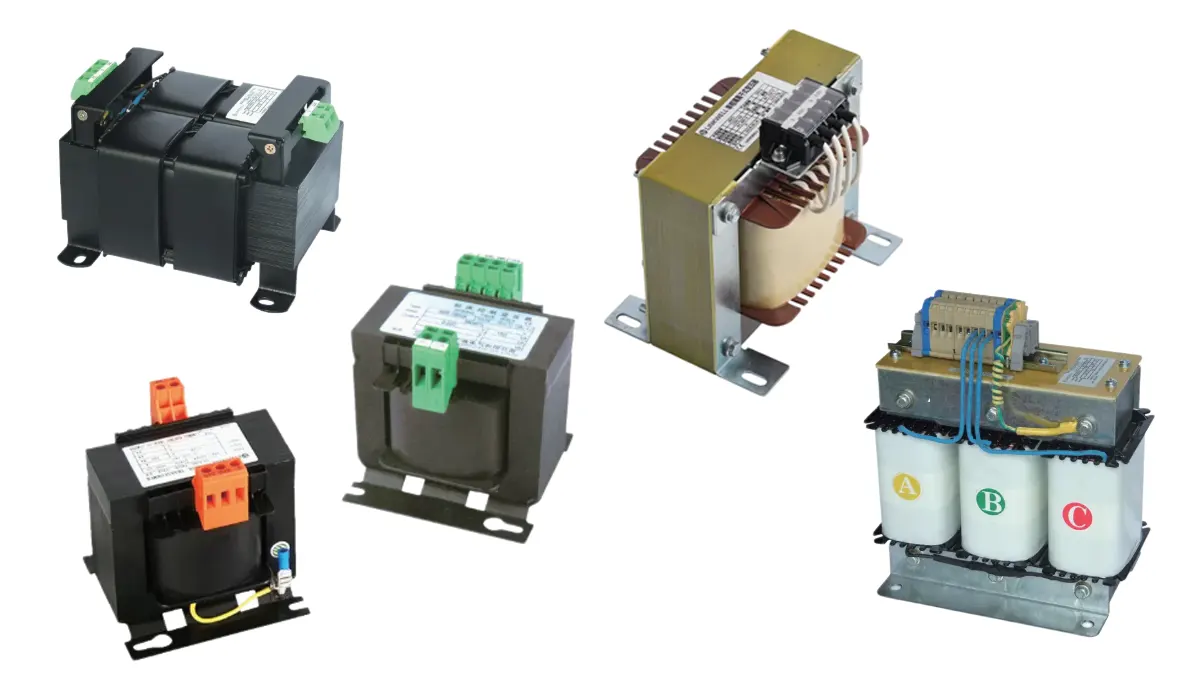
Correctly sizing three-phase transformers is fundamental for ensuring electrical system efficiency, safety, and longevity. An undersized transformer can lead to overheating and failure, while an oversized one is unnecessarily expensive.
This ultimate guide explores the critical factors and steps involved in accurately determining the right transformer size for your specific three-phase applications, avoiding costly errors and ensuring reliable performance.
What are Three Phase Transformers
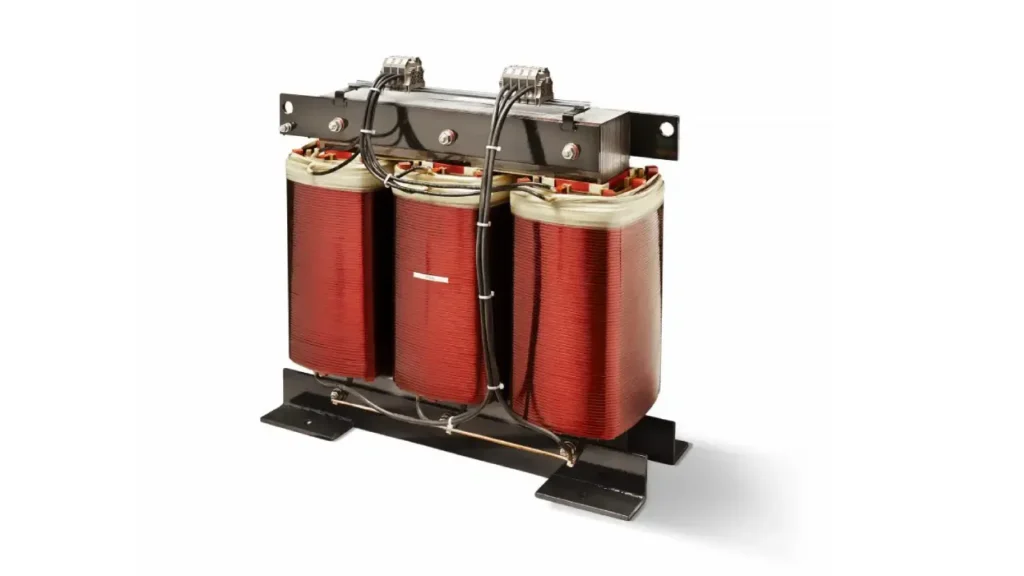
A three-phase transformer is an electrical device designed to transfer electrical energy between three circuits.
Unlike a single-phase transformer which works with one alternating voltage, a three-phase transformer manages three alternating voltages that are offset in phase from one another, typically by 120 degrees. This makes them essential for high-power industrial and commercial applications where efficient generation, transmission, and distribution of electricity are required.
Step-by-Step Guide to Selecting Standard Transformer Sizes
Selecting the correct transformer size (measured in kVA) is a critical engineering decision that balances efficiency, safety, and cost. While calculations are essential, your final choice must be made from a range of standard, commercially available transformer sizes. This guide provides a clear, four-step process to go from your electrical load to the optimal standard transformer.
Step 1: Calculate Your Total kVA Load Requirement
The first step is to accurately determine the total electrical demand of all equipment that will be supplied by the transformer.
For a Three-Phase System, use this formula:Total kVA = (Volts x Amps x 1.732) / 1000
- Volts: The line-to-line voltage of your system (e.g., 208V, 240V, 480V).
- Amps: The total full-load current of all connected three-phase equipment.
- 1.732: The square root of 3 (√3), the constant for three-phase power calculations.
Example Calculation:
If you have a facility with a total three-phase load drawing 280 Amps on a 480V system:kVA = (480V x 280A x 1.732) / 1000 = 232.9 kVA
Important: For single-phase loads within a three-phase system, calculate their kVA separately (kVA = Volts x Amps / 1000) and add them to the total. A detailed load schedule is always recommended.
Step 2: Apply a Future Growth & Safety Factor
A transformer should not be loaded to 100% of its capacity continuously. To ensure longevity, provide a buffer for unexpected load additions, and account for future expansion, you must add a safety margin to your calculated kVA.
A common industry practice is to add a 15-20% safety factor.
Continuing our example:232.9 kVA + 20% = 232.9 kVA x 1.20 = 279.5 kVA
This adjusted figure represents the minimum kVA rating your transformer should have based on load and planning.
Step 3: Round Up to the Nearest Standard kVA Size
This is the crucial step where theory meets practice. Transformer manufacturers produce units in standard sizes for efficiency and interchangeability. You must always round your required kVA UP to the next available standard size.
Common Standard Three-Phase Transformer Sizes (kVA):
- Low Power: 30, 45, 75, 112.5, 150, 225, 300, 500
- Medium Power: 750, 1000, 1500, 2000, 2500
Final Selection from our example:
Our calculated requirement was 279.5 kVA. Looking at the standard list, the next available size is 300 kVA. Therefore, a 300 kVA transformer is the correct standard choice for this application.
Step 4: Verify Full-Load Current & Compatibility
With your standard size selected, perform a final verification. Calculate the transformer’s full-load output current to ensure it exceeds your load’s ampacity and that downstream protection devices (breakers, cables) are appropriately sized.
Use the formula in reverse:Full-Load Amps (FLA) = (kVA x 1000) / (Volts x 1.732)
For our selected 300 kVA, 480V transformer:FLA = (300 kVA x 1000) / (480V x 1.732) = 360.8 Amps
Since 360.8 Amps is greater than our original load of 280 Amps, the 300 kVA transformer is electrically sufficient.
Three Phase Transformer Sizes
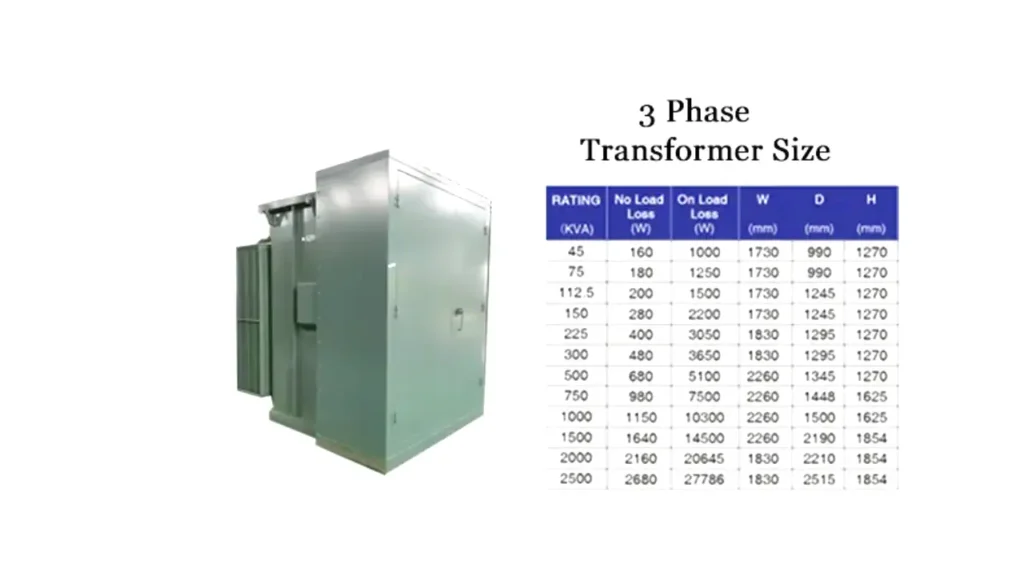
Understanding the typical sizes of three-phase transformers is essential for matching the right unit to the power demands of various applications. These sizes are generally categorized based on their kVA ratings, indicating their power handling capacity.
Small Three Phase Transformers
Small three-phase transformers typically range from a few kVA up to around 75 kVA. These sizes are often used for lighter industrial loads, small commercial buildings, and specific equipment power requirements where the total three-phase load is relatively modest. They are compact and suitable for installations with limited space, providing the necessary voltage transformation for smaller scale operations.
Medium Three Phase Transformers
Medium-sized three-phase transformers usually fall within the range of 75 kVA to approximately 500 kVA. This category serves a broader array of applications, including medium-sized industrial facilities, larger commercial complexes, and distribution substations within localized networks. They balance capacity with physical footprint, offering a versatile solution for growing power needs.
Large Three Phase Transformers
Large three-phase transformers span from 500 kVA up to several thousand kVA (e.g., 5000 kVA or more). These are designed for heavy industrial loads, large manufacturing plants, and primary distribution substations that feed power to extensive areas. Their construction is more robust, often requiring forced cooling methods to manage the significant heat generated by high power transfer.
Power Three Phase Transformers
Power transformers represent the largest category, typically starting from several MVA (mega-volt-amperes) and going up to hundreds or even thousands of MVA. These colossal transformers are critical for high-voltage transmission networks, stepping up voltage at power generation plants for long-distance transmission and stepping it down at major substations. They are custom-built for specific grid requirements and are central to the bulk movement of electrical energy.
Here is a table summarizing typical three-phase transformer sizes:
| Size Category | Typical kVA Range | Common Applications |
| Small | Up to 75 kVA | Light industrial, small commercial, specific equipment |
| Medium | 75 kVA to 500 kVA | Medium industrial, larger commercial, local distribution |
| Large | 500 kVA to ~5000 kVA | Heavy industrial, large manufacturing, primary distribution |
| Power | Several MVA and above | Power generation, high-voltage transmission substations |
How to Size a Three Phase Transformer?

Sizing a three-phase transformer involves calculating the required capacity to meet the load demand, considering factors like voltage, current, and future expansion, ensuring efficient and reliable power distribution for your specific application needs.
Determine the Total Load
The first step in sizing a three-phase transformer is to accurately determine the total connected load. This involves summing the power requirements (in kVA or MVA) of all equipment and devices that will be connected to the transformer. It’s crucial to consider both continuous loads (like lighting or motors running constantly) and non-continuous loads (like welding machines or HVAC units that cycle on and off) to get a comprehensive picture of the demand.
Calculate the Full Load Current
Once the total load in kVA is known, the full load current can be calculated using the formula: Current (Amps) = kVA / (√3 * Voltage (Volts)). This calculation is essential because it dictates the size of the conductors and protective devices connected to the transformer, ensuring they can safely handle the maximum expected current draw under full load conditions.
Consider Load Diversity and Future Growth
Load diversity refers to the fact that not all connected loads will operate simultaneously at their maximum capacity. Applying a diversity factor can help refine the estimated load, potentially allowing for a smaller, more cost-effective transformer. Additionally, it is vital to anticipate future load growth and add a suitable buffer (typically 15-25%) to the calculated load to avoid oversizing or undersizing the transformer, which can lead to inefficiency or premature replacement.
Select the Appropriate kVA Rating
Based on the calculated total load, adjusted for diversity and future growth, select a standard transformer kVA rating that is equal to or greater than the required capacity. Transformer manufacturers produce units in standard kVA sizes (e.g., 75 kVA, 150 kVA, 300 kVA), and choosing the closest standard size above your calculated requirement ensures the transformer can handle the load without overheating or premature failure.
Verify Voltage and Impedance
Ensure the selected transformer’s primary and secondary voltage ratings match the available power source and the requirements of the connected load. The transformer’s impedance, usually expressed as a percentage, is also an important factor as it affects voltage regulation and fault current levels; verify that the impedance is suitable for the application and coordination with protective devices.
Why Three Phase Transformer Size Matters?
Proper sizing of a three-phase transformer is critical for both initial investment and operational performance. An oversized transformer represents an unnecessary upfront expense and can operate less efficiently, particularly at light loads, leading to wasted energy. It also requires more physical space. Conversely, an undersized transformer risks operating in overload conditions, which can lead to several problems:
- Poor voltage regulation, potentially affecting connected equipment performance.
- Increased operating temperature due to excessive current.
- Reduced immediate efficiency under heavy load.
Beyond immediate performance issues, incorrect transformer sizing has significant long-term consequences. An undersized transformer subjected to constant overheating will experience accelerated insulation degradation, drastically shortening its lifespan and increasing the likelihood of premature failure. This leads to costly downtime and replacement Operating a transformer outside its intended capacity can compromise safety:
- Increased risk of thermal runaway and potential fire hazards.
- Damage to connected equipment due to unstable voltage or harmonics under overload.
- Non-compliance with electrical codes and standards, posing safety and legal risks.
How to Choose the Suitable Three Phase Transformer Sizes?
Choosing the suitable size for a three-phase transformer requires accurately determining the total electrical load, applying appropriate factors for simultaneous operation and future needs, and selecting a standard manufacturer size that safely exceeds the calculated requirement for reliable performance.
Calculate the Total Connected Load
Begin by listing all equipment and their power requirements served by the transformer, summing the kVA ratings of all connected loads. For motor loads, use the full-load kVA, and for non-motor loads, use their nameplate kVA or calculate it from voltage and current to find the apparent power for a comprehensive total.
Apply Demand and Diversity Factors
Not all loads will operate simultaneously at their peak. Apply a demand factor to individual loads that cycle on/off and a diversity factor to the total load to account for the non-simultaneous operation of different loads. This can potentially reduce the total effective load used for sizing compared to the simple sum, reflecting actual peak usage.
Add a Safety Margin for Future Growth
To accommodate potential future expansion or unforeseen load increases, add a safety margin, typically 15% to 25%, to the calculated effective load. This ensures the transformer is not undersized and has adequate capacity for additional equipment or changes in operational demands over its lifespan, providing a buffer against overloading.
Verify Voltage Specifications
Confirm that the chosen transformer’s primary (input) and secondary (output) voltage ratings precisely match the requirements of the power source and the equipment being served. Incorrect voltage can damage both the transformer and the connected loads, so verifying voltage compatibility is a critical step in selecting the appropriate unit for safe and efficient operation.
Select from Standard Sizes
Compare your final calculated load, including diversity and safety margins, to the available standard kVA sizes offered by transformer manufacturers. Always choose the next standard kVA size that is equal to or greater than your calculated requirement. This ensures the transformer operates within its safe capacity and is readily available from suppliers.
Conclusion
Inside a transformer, stability and reliability are crucial. Correctly sizing three-phase transformers is vital for efficiency and longevity, preventing costly issues from improper capacity. This guide provided essential knowledge to match transformer size precisely to your load and voltage needs.
Applying this knowledge ensures reliable power delivery for your applications.
Mastering sizing is key. For your wholesale three phase transformers, get them from Linkwell Electrics, ensuring quality for your correctly sized needs.